Built for the WebMCP Challenge · 2026
LaunchPad
Follow the
evidence.
A research workspace where you can inspect what supports an idea, challenge its assumptions, and follow the reasoning back to its source.
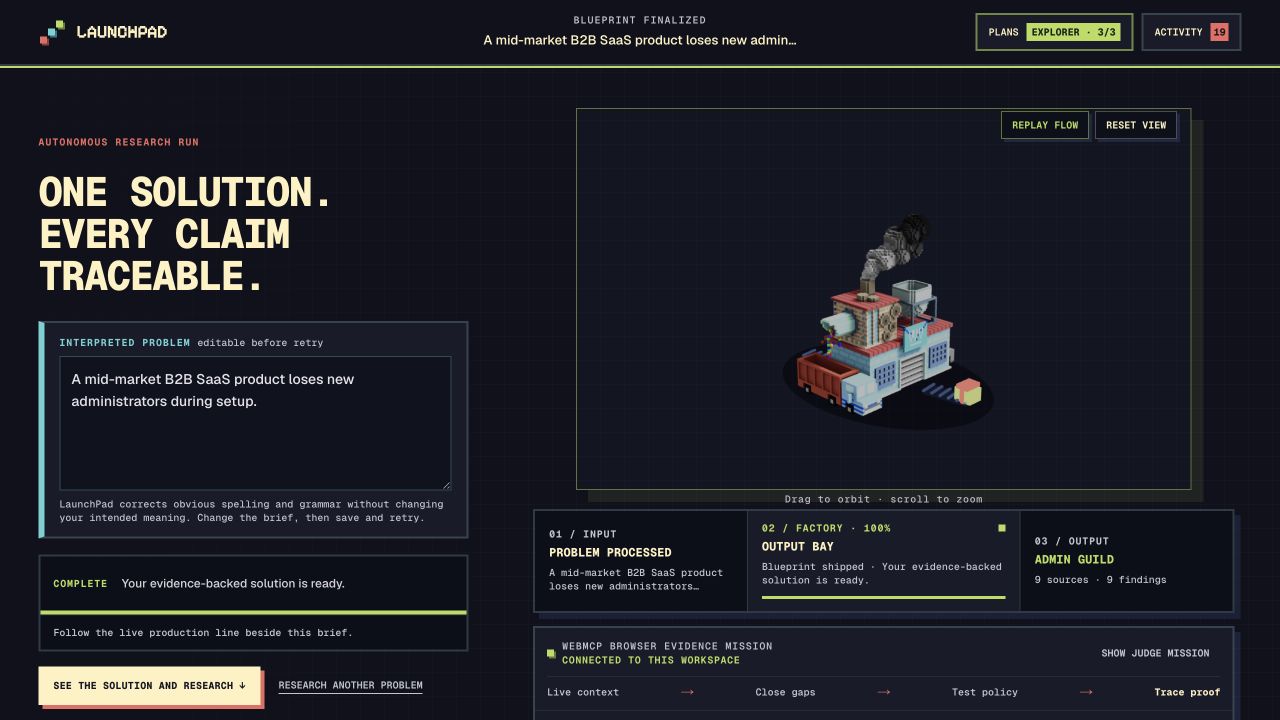 View full size
 Give an idea a production line.
One problem enters. Research, evidence review, synthesis, and stress testing move it toward a recommendation. The factory reflects the real workspace stage as it progresses.
The factory is a window into the workflow. Select a station in the live app to inspect its role and progress.
Every decision has a backstory.
Explore the four steps in LaunchPad’s evidence model.
Read the build storyDecision: A specific feature or mechanism in the proposed solution.
Overview
LaunchPad turns a problem statement into a research-backed recommendation, with the supporting sources, counter-evidence, assumptions, and validation plan attached. Built for the WebMCP Challenge, it lets a person and a browser agent work inside the same visible workspace. A voxel factory brings the process to life as the research moves from an initial question to a blueprint worth testing.
Technologies Used
Business Need
Product and strategy teams have plenty of AI-generated answers, but still need to defend the decisions behind them. Research gets scattered across papers, market reports, community discussions, and internal observations. When an assumption is challenged, it is difficult to tell which parts of a recommendation still stand.
Purpose
To make the reasoning behind a recommendation inspectable: gather evidence, keep contradictions visible, test the assumptions, and give a team a concrete next experiment.
Key Functionalities
- •Autonomous research: Investigates the submitted problem with server-side web search, checks report URLs against search results, and asks for missing essentials when a request needs clarification.
- •A visible research factory: A Three.js scene reflects the workspace stage and progress, making the journey from problem to solution tangible.
- •Shared human–agent workspace: 22 WebMCP tools across the full catalog expose stage-relevant actions through the same domain service used by the interface.
- •Evidence policy experiments: Preview how source type, recency, geography, corroboration, and privacy rules affect candidate support. Apply or roll back the policy while keeping the full evidence ledger.
- •Traceable decisions: Follow a recommendation component through its insight and finding to the original source, with caveats and provenance attached.
- •Visible consent: Sensitive evidence review, finalization, and private exports pause for human approval tied to exact records and the current workspace version.
Advantages
- •A recommendation you can interrogate: Supporting evidence and counter-signals stay connected to the decisions they affect.
- •Less context switching: The browser agent works on the same problem, evidence gaps, and workspace state the person can see.
- •Reversible judgment calls: Changing an evidence policy recalculates support without deleting sources or losing review decisions.
- •A practical handoff: The final blueprint includes risks, unproven assumptions, and a validation plan, with a public-safe export option.
Key Learnings
- •Evidence needs a data model. A list of citations alone cannot explain which feature loses support when a finding is excluded.
- •A useful agent tool needs clear preconditions, bounded results, recovery actions, and visible effects in the product.
- •Consent has to be bound to a specific action and workspace version; an earlier approval should not authorize a different decision.
- •Animation is most useful when it explains real progress. The factory takes its cues from the same state that drives the workbench.
Challenges Faced
- •Keeping human controls and asynchronous agent operations consistent as the workspace advances through research, review, stress testing, and finalization.
- •Separating citation-linked AI paraphrases from verbatim excerpts, while retaining contradictory findings instead of generating an overly confident answer.
- •Making evidence policies reversible and ensuring previews do not mutate the workspace they are meant to inspect.
- •Keeping an end-to-end judging demo reproducible while recording provider rate limits honestly in the separate agent-evaluation results.
Key Accomplishments
- •Built the complete problem-to-blueprint workflow with a shared TypeScript domain service, evidence gates, provenance, policy comparison, and export.
- •Created a stage-aware WebMCP integration with strict tool schemas, asynchronous registration, cancellation, and compact versioned receipts.
- •Recorded a public-host browser journey with 26 tool calls from workspace v1 to v19, including policy apply/rollback, human consent, a four-hop proof trace, and public-safe export.
- •Produced a founder-led product walkthrough showing both the decision workflow and the business problem it addresses.